

Introduction
Right knee pain is among the most commonly reported musculoskeletal complaints in clinical settings. Whether it stems from an injury, chronic condition, or unclear cause, accurate diagnosis coding is essential for effective treatment planning and timely reimbursement. That’s where the ICD 10 pain right knee code comes in.
In this comprehensive guide, you’ll learn how to correctly apply the ICD 10 pain right knee codes in 2025, avoid common billing errors, and ensure your documentation meets payer standards. Whether you’re a medical coder, provider, or physical therapist, this article breaks down what you need to know for smooth and compliant coding.
What Is the ICD 10 Code for Pain in Right Knee?
The official ICD-10-CM code for ICD 10 pain right knee is:
M25.561 – Pain in right knee
This is a billable and specific diagnosis code used when a patient presents with localized pain in the right knee, and no definitive underlying diagnosis has yet been confirmed (such as arthritis or traumatic injury).
It is crucial to use this code when the ICD 10 pain right knee is a primary symptom and not yet tied to a more specific condition.
Related ICD-10 Codes for Knee Pain
While ICD 10 pain right knee is covered under M25.561, other relevant codes include:
| Code | Description |
|---|---|
| M25.561 | Pain in right knee |
| M25.562 | Pain in left knee |
| M25.569 | Pain in unspecified knee |
Note: Only use M25.569 if it is not evident from the documentation which knee is affected. Steer clear of overusing nonspecific codes since they frequently result in claims being denied or additional paperwork being requested.
When to Use M25.561 vs. Other Codes
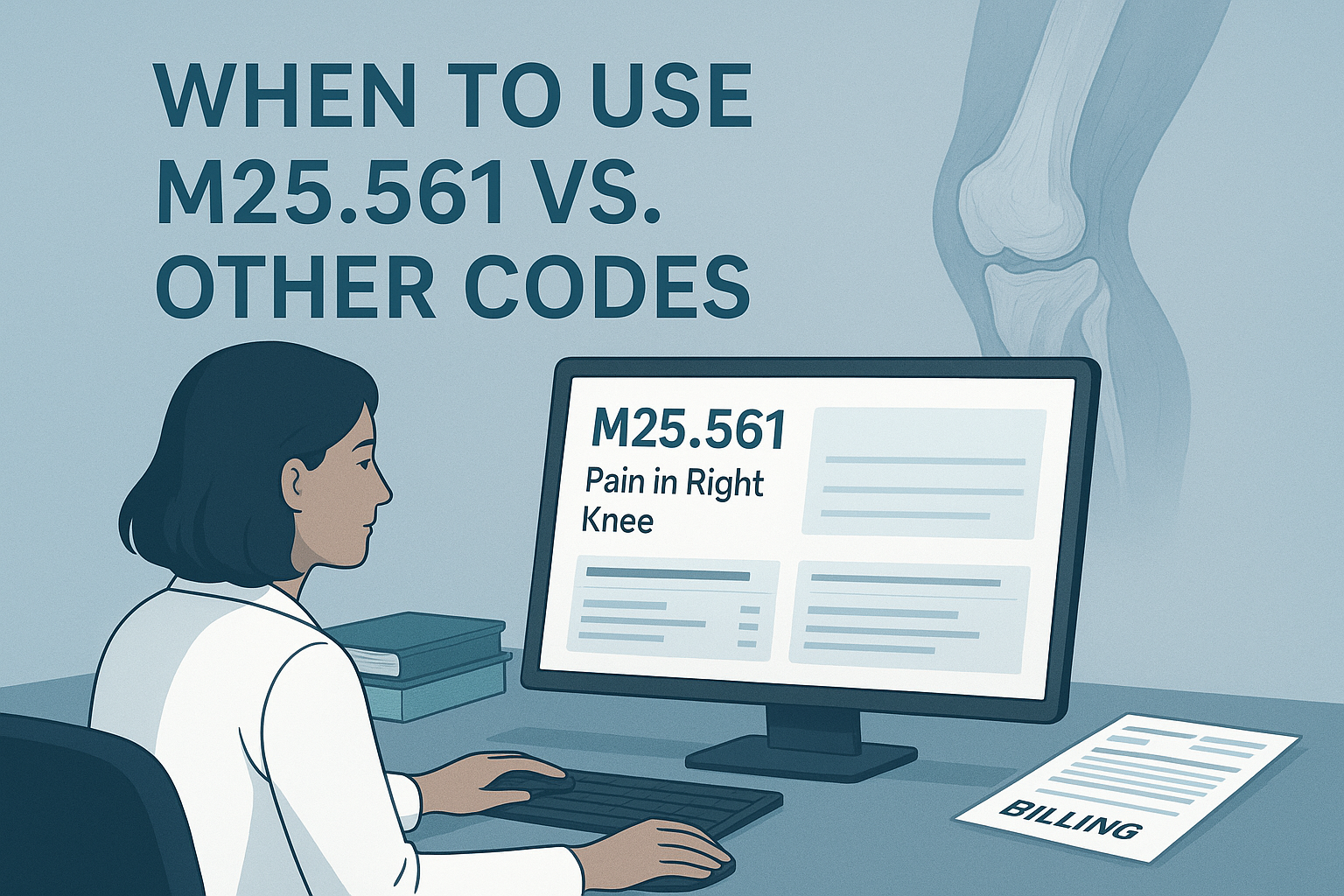
Use ICD 10 pain right knee code M25.561 when:
- The patient presents with right knee pain
- No specific pathology (e.g., arthritis, meniscus tear) has been confirmed
- The clinician is in the early stages of evaluation
- Pain is the primary symptom and not yet explained by imaging or testing
Switch to a more specific code when diagnostic clarity is achieved.
Common ICD 10 Pain Right Knee Coding Mistakes
- Using Unspecified Code Without Justification
Avoid using M25.569 when laterality is clearly documented. Insurers expect precise coding, and unspecified codes increase denial risks in ICD 10 pain right knee cases. - Assigning a Specific Diagnosis Too Early
If diagnostic testing is incomplete or the provider hasn’t confirmed a condition like osteoarthritis or ligament tear, avoid jumping to M17 or S83 codes prematurely. Until you have a better notion, start with ICD 10 pain right knee code M25.561. - Overlooking Chronic Pain Indicators
In chronic pain scenarios, failing to add a G89.29 code alongside M25.561 results in incomplete documentation. Always note duration in clinical notes and reflect it in your ICD 10 pain right knee coding.
Documentation Tips for Right Knee Pain
Strong documentation is essential to support the ICD 10 pain right knee code and prevent payer pushback. Your notes should include:
- Laterality: Clearly state “right knee”
- Pain duration: Acute or chronic
- Context or mechanism of injury (if applicable)
- Functional limitations or impact on mobility
- Physical exam findings: Swelling, tenderness, ROM
ICD 10 Pain Right Knee in Practice: Clinical Scenarios
Primary Care Example:
The patient has come in for an assessment of recent ICD 10 pain right knee symptoms, with no previous medical history related to this issue. Provider performs basic examination and refers to imaging.
Physical Therapy Example:
A patient is referred to PT for ICD 10 pain right knee after surgery, with no complications noted. Pain is localized, moderate, and persistent.
Orthopedic Example:
Patient presents with 3-month history of ICD 10 pain right knee symptoms. Imaging reveals osteoarthritis.
Billing and Reimbursement Considerations
Using ICD 10 pain right knee accurately can significantly affect revenue cycle performance.
| Service Type | CPT Code | ICD-10 Code(s) |
|---|---|---|
| Initial Office Visit | 99203 | M25.561 |
| Physical Therapy Session | 97110 | M25.561 |
| Follow-up Visit (Chronic) | 99213 | M25.561 + G89.29 |
Benefits of Accurate ICD 10 Coding for Pain in the Right Knee
- Faster claim approvals
- Fewer insurer denials
- Improved clinical tracking
- Better patient care coordination
- Compliance with payer audits and CMS rules related to ICD 10 pain right knee
2025 Updates: What’s Changed?
For the 2025 ICD-10 code set (effective October 1, 2024), ICD 10 pain right knee code M25.561 remains unchanged, but coding compliance standards continue to tighten. Emphasis is placed on avoiding unspecified codes and ensuring documentation supports clinical necessity.
Frequently Asked Questions (FAQ)
1. What is the ICD 10 code for right knee pain?
The ICD-10-CM code for right knee pain with no known underlying cause is M25.561.
2. Is it appropriate to use M25.561 for chronic knee pain?
Yes. Pair it with G89.29 to indicate chronic pain. Documentation should reflect pain duration.
3. When should I switch from M25.561 to a more specific code?
As soon as a confirmed diagnosis (e.g., arthritis, injury) is made via imaging or exam.
4. Is M25.561 valid for insurance billing?
Yes, it is a billable and valid ICD-10 code when supported by appropriate documentation.
5. Should physical therapists use M25.561?
Absolutely. Physical therapists commonly use ICD 10 pain right knee codes like M25.561 to document and justify treatment.
6. What happens if I use the unspecified code (M25.569)?
Unspecified codes may result in delayed or denied claims, especially if documentation supports laterality.
7. Can M25.561 be used for post-surgical pain?
Yes, but only if the pain is unrelated to complications. If complications exist, use a more specific code.
Conclusion
Correctly applying the ICD 10 pain right knee code can make a big difference in how healthcare organizations document care, manage claims, and track outcomes. When a patient’s ICD 10 pain right knee is their main concern and no precise diagnosis has been made, M25.561 is the code to use.