

Introduction
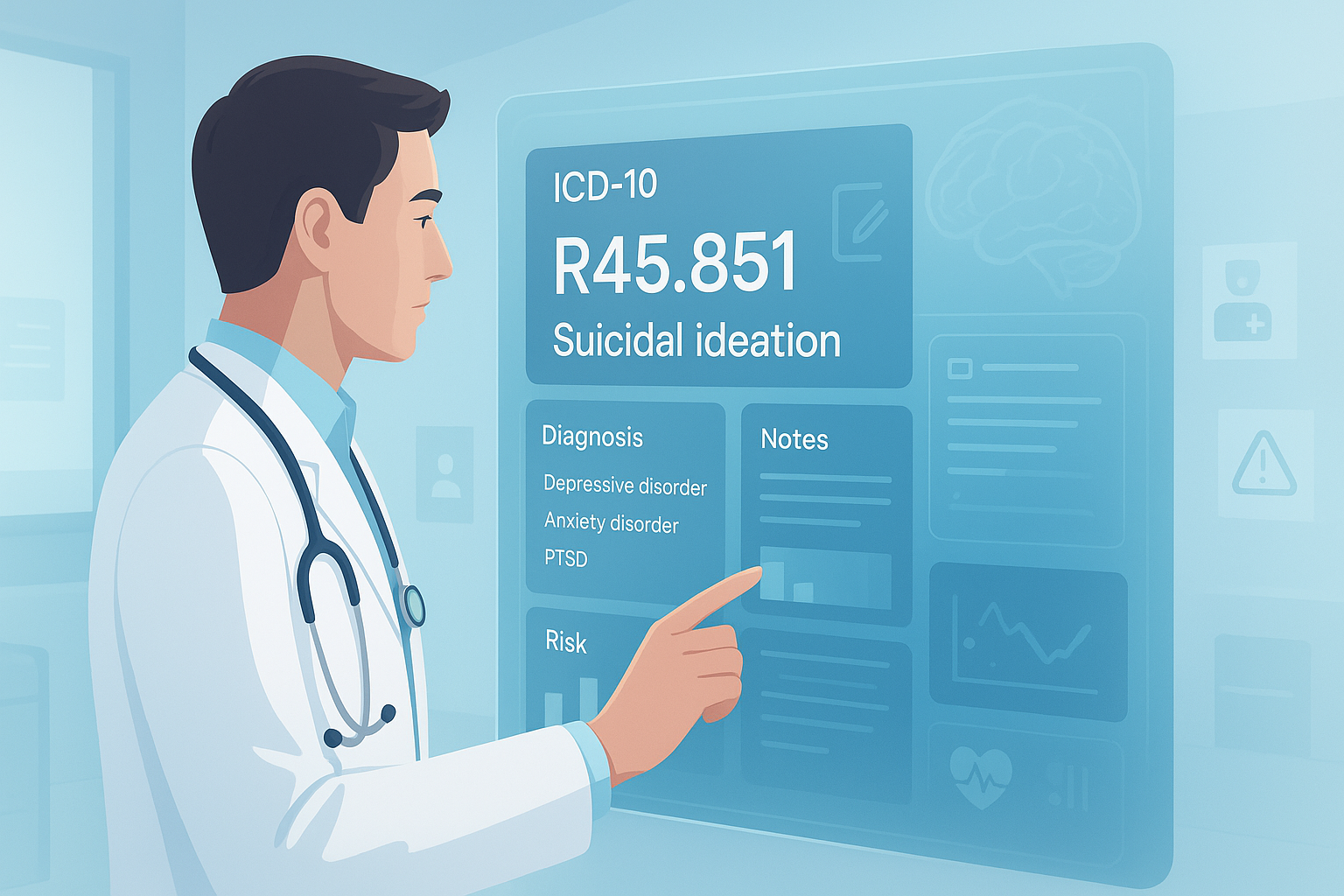
Accuracy is key in clinical documentation and medical billing. Mental health is one area that needs clarity especially when it comes to suicidal thoughts. Suicidal ideation’s ICD 10 code is essential for recognizing and classifying high-risk mental health disorders. In order to guarantee appropriate treatment and payment, this article will dissect the code, clinical application, and best practices for documentation.
ICD 10 Code for Suicidal Ideation?
R45.851 – This code is used to document a patient’s expression of suicidal thoughts or ideation, whether passive (e.g. “I wish I could disappear”) or active (e.g. “I want to end my life and I have a plan”). This code does not apply if an actual suicide attempt has occurred.
Why Accurate Coding Matters
Accurate coding of ICD 10 code for suicidal ideation is important for:
- Clinical clarity: It tells providers about the patient’s mental health risk.
- Billing accuracy: So claims get processed correctly.
- Data tracking: So public health agencies and institutions can track trends and allocate resources.
- Legal documentation: So you have a clear medical record for liability and continuity of care.
When to Use R45.851
The ICD 10 code for suicidal ideation should be used when:
- A patient reports suicidal thoughts without having taken any actions.
- There is clear documentation of suicidal ideation in the clinical note.
- Suicidal ideation is a current, active concern that impacts care planning.
This code is not appropriate for vague hopelessness, passive death wishes without suicidal intent, or actual suicide attempts.
How to Document Suicidal Ideation
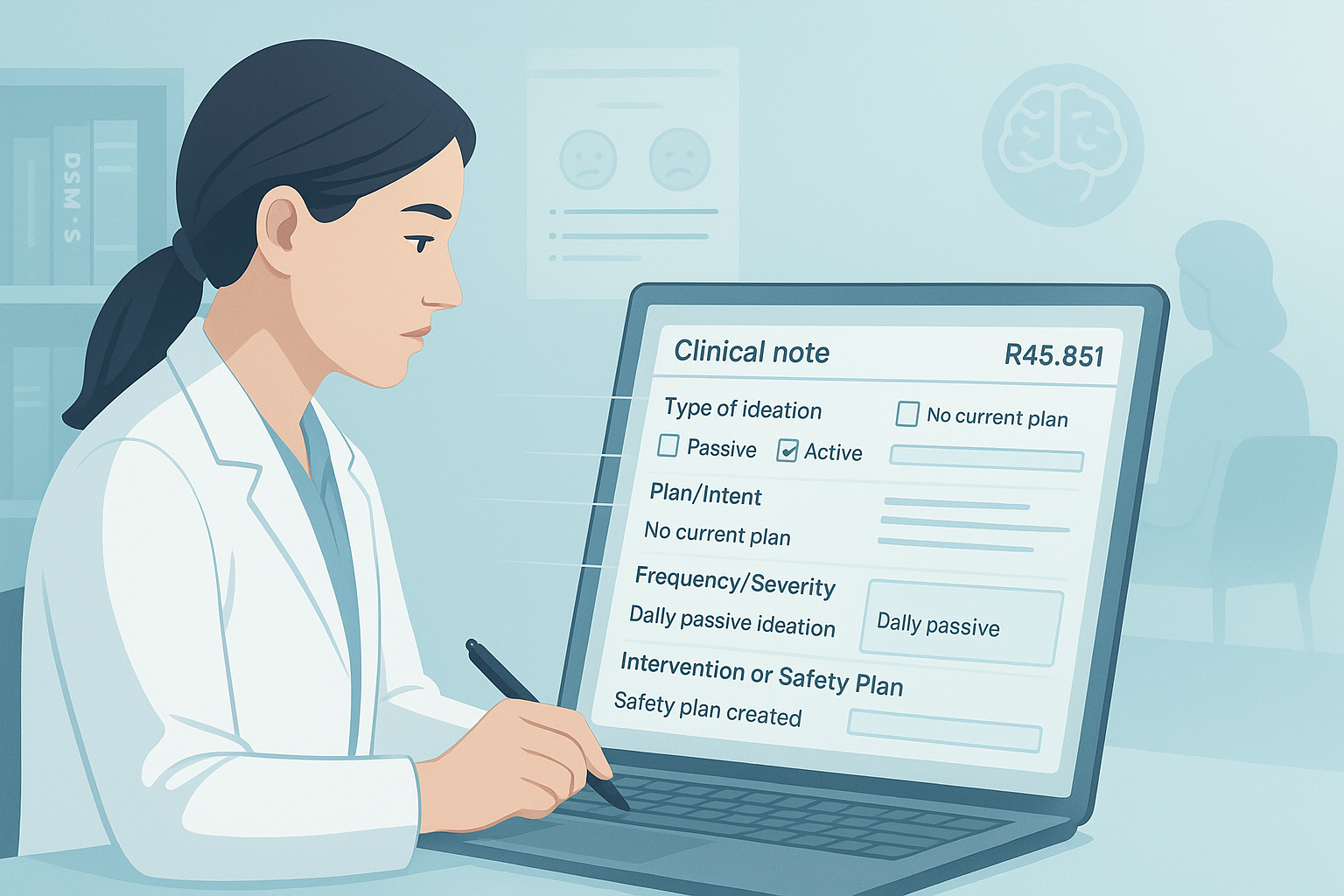
When using the ICD 10 code for suicidal ideation, be specific. Include:
- Type of ideation: Passive vs active
- Plan or intent: Does patient have a plan
- Severity and frequency: Sporadic versus daily
- Protective factors: Include children, religion, support networks, etc.
- Clinical intervention: Hospitalization, referrals, and safety planning
Example:
“Patient reports daily suicidal thoughts with no plan but no current intent. No prior attempts. Supportive spouse present. Safety plan created.”
This type of documentation justifies the use of R45.851 and guides proper clinical care.
Related ICD 10 Codes to Consider
While R45.851 is the primary code, you may also need to consider related codes for a fuller clinical picture:
| Code | Description | Use Case |
|---|---|---|
| T14.91 | Suicide attempt, unspecified | When an actual suicide attempt has occurred |
| Z91.5 | Individual self-harm history | When a history of prior self-harm is recorded |
| F33.1 | Moderate recurring major depressive disorder | Frequently combined with thoughts of suicide |
| F43.10 | Unspecified post-traumatic stress disorder | If the ideation is influenced by PTSD |
Use these codes with R45.851 when applicable, following coding hierarchy rules.
Coding Hierarchy and Best Practices
- Never use both R45.851 and T14.91 for the same visit.
- Z codes: Z91.5 is for history of self-harm not current behavior.
- You can code suicidal ideation in both inpatient and outpatient settings with these guidelines.
Coding Suicidal Thoughts Is Challenges
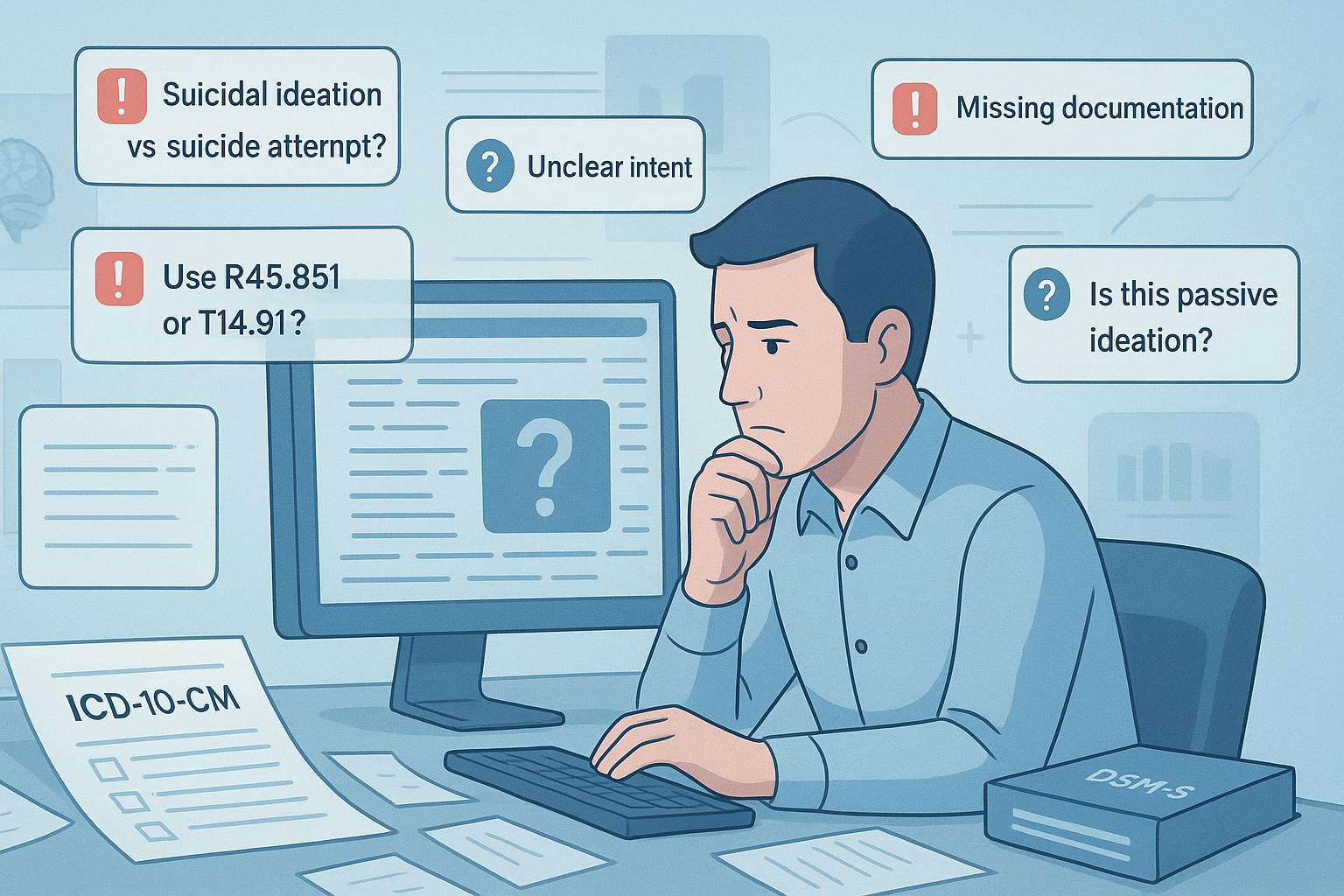
Despite the guidelines there are many issues:
- Under-documentation: Many clinicians don’t document the ideation clearly and miss the coding opportunity.
- Coding errors: Mistaking ideation for an attempt, or vice versa, results in incorrect ICD usage.
- Lack of specificity: General statements such as “patient is not doing well psychologically” are not enough to support R45.851 billing.
Effective use of the ICD 10 code for suicidal ideation requires the right education and knowledge.
Clinical Example
A 28 year old comes in with worsening depression. No plan or intent to act but admits to thinking about suicide every night and feels down during the visit. They have never before tried to end their lives.
Correct coding:
- F33.1 – Moderate, recurring major depressive disorder
- R45.851 – Suicidal ideation
ICD 10 code for suicidal ideation is supported by clinical documentation and is secondary to the primary diagnosis.
Impact on Patient Care
Using the ICD 10 code for suicidal ideation correctly has real life benefits:
- Timely intervention: High risk patients get immediate psychiatric evaluation.
- Safe: Triggers safety planning and follow up.
- Quality metrics: Helps healthcare system reporting for mental health.
Inaccurate coding can result in poor results, service gaps, and provider responsibility.
FAQs
1. What is the ICD 10 code for suicidal ideation?
R45.851 is the ICD 10 code for a patient who has suicidal thoughts but has not attempted suicide.
2. If the patient made an attempt at suicide, can I still apply R45.851?
No. If a suicide attempt has occurred, use T14.91 instead. R45.851 is only for ideation without action.
3. What’s the difference between passive and active ideation?
- Passive ideation: Thoughts like “I wish I were dead.”
- Active ideation: Thinking about ending one’s life, possibly with a plan.
Both fall under R45.851, but documentation must clarify the difference.
4. Is R45.851 a billable code?
Yes, the ICD 10 code for suicidal ideation is billable and recognized for reimbursement purposes.
5. Should I document ideation even if it’s fleeting?
Yes. Any expression of suicidal thoughts should be documented. However, use clinical judgment to decide if coding R45.851 is warranted.
6. Can R45.851 be used with a depression diagnosis?
Absolutely. If suicidal ideation is a symptom of a condition like depression, code the mental health condition first, followed by R45.851.
7. What if the patient has a history of attempts but no current ideation?
Use Z91.5 – personal history of self-harm. Do not use R45.851 unless current ideation is present.
Conclusion
ICD 10 codes for suicide considerations exceed one billing number; this is a warning indicator in the patient’s mail, which requires notice of care. Appropriate journals, clinical follow-ups and accurate coding are life case strategies. To know when and how to use R45.851, it can ensure compliance, refund and successful crisis reactions.